Virtual Pro Wrestling - How Many Backdrop Variants Can There Be???
I wanted a full profile for every wrestler in a 1996 PS1 game, which meant knowing every move. So I taught the emulator's debugger to perform and film all of them, and I dug into how spirit and counters decide a match.
Contents
Game Overview
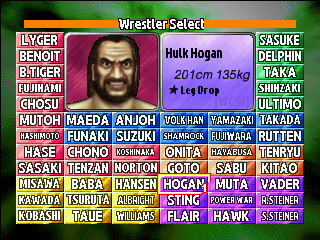
Virtual Pro Wrestling (バーチャル・プロレスリング) is a one-on-one 3D wrestling game from Asmik Ace Entertainment, developed by AKI Corporation, released on the PlayStation in Japan on 13 September 1996. It never left Japan under this name, but it did come to North America in a different form: as WCW vs. the World (SLUS-00455), built on the same engine. The Western release swapped out part of the roster. Comparing the two discs, 17 of the Japanese wrestlers have no counterpart there, and 17 of the American ones are replacements. It has sixty wrestlers from several real promotions, a grapple system driven by how close you are when you tap, and no health bar.
The English patch translates everything the player reads: the seven modes, rule settings, match banners, tournament and league screens, belt screens, Memory Card prompts, and the name tiles and bio boxes for all 60 wrestlers. The wrestler names come in two flavours, real names or the game’s own parody names. The hard part was text. The game draws Japanese from the console’s BIOS font, so the patch adds an English half-width text routine and redraws the text-in-picture graphics by hand.
The menus were the easy part to explain. What I was really excited about was the guide: a full profile for every wrestler, moves included.
The Goal: A Profile for Every Wrestler
When the translation was done I wanted to go further and make a proper roster guide: a profile for each of the 60 wrestlers, with stats and a full move list. Knowing what moves someone has is the heart of a profile, so I needed to find every move, see it and name it.
The challenge is that the game keeps its moves to itself. There is no move list, no announcer text and no move name in the data or the executable. The bio box has a “signature move” label, but it is only part of the picture. If I wanted names, I would have to perform every move, watch it, and name it myself.
The scale made it interesting. Here are the real numbers, counted from the data and the finished captures:
Most of that is reuse. 393 of the 538 animations are used by more than one wrestler, and one of them turns up 44 times. How much variety a slot has depends on what it is:
And the question in the title: there are 48 backdrops across 42 wrestlers. They come in 6 names (Backdrop, Backdrop Suplex, Backdrop Suplex Pin, Backdrop Suplex Snap, Lift-up Backdrop and Spinning Backdrop), and underneath those are 9 distinct animations.
Getting the game to throw a particular move by hand means being at the right distance, facing the right way, pressing the right buttons, with the opponent in the right state. Doing that over 500 times, for about 32 minutes of footage, was not appealing.
So the plan was to make the game do it for me. The aim was one short animated clip per move, so the guide could show it and I could look any move up in a few seconds.
Filming the Moves
Step one: where the moves live
Each wrestler is one file on the disc, DAnn.DAT. It holds 42 action records of 13 bytes each, then 102 animation headers of 32 bytes. A record says how hard the move hits (power), how much spirit each side gains or loses, which body part wears, and what kind of move it is: plain hit, hit with a KO check, throw, hold.
Power30
Not decoded0 in most records
Active frameswhen it can hit
Spirit changeyou +0, him −7
Stats usedyour offence 3 vs his defence 2
Wear5 off his body part
Postureground holds only
Move type2 = throw
Not decodedFF in most records
The important part: the game itself chooses a record from your inputs. The grapple selector is only a few dozen instructions in MAIN.EXE. It reads Up and Down (Left and Right do nothing), whether Circle was tapped or held, and the distance to the opponent. Closer than 0x74 (116 units) is a close tap, records 7/8/9. Further is a far tap, 4/5/6. Hold gives 10/11/12. Behind the opponent is 17-20.
Because the numbers belong to the slot and not the wrestler, the same slot is the same input on every wrestler. I only had to understand 42 slots, and then name what each of 60 wrestlers does in them.
Step two: let the debugger be the player
I run the game in DuckStation, which has a GDB server. A small Python library talks to it over the network and can read and write RAM and registers while the game runs. That gave me three tricks.
A reset button. I played into a match once, then froze the game at a fixed point in the frame loop (0x8003BAB4, right before player 1’s pad is copied). At that stop I save the registers, the 2 MB of RAM and the scratchpad. To reset, I write back only the 1 KB blocks that differ plus the registers. It takes about 0.4 s, and it works even after a match has finished: the double count-out result screen came back to the ring.
Fake controller input. The game reads the pad at two instructions. I overwrite them in memory with a load of a constant, so player 1 “presses” whatever I say:
; every frame, just before the game copies player 1's pad:
held_buttons = PAD     ; was: held_buttons = read_pad(1)
new_presses  = PAD     ; was: new_presses  = read_pad(1)
; Circle = 0x20.  A tap is PAD for 1-3 frames, a hold is about 6.
Any wrestler’s moves on one model. The ring is already loaded with Benoit and Takada, and I can’t reload the match for every wrestler. But the action code reads records and animations straight from the wrestler file. So I copy DAnn.DAT over player 1’s file at 0x80142000, relocate its 102 animation offsets, and the model performs that wrestler’s moves. They share a skeleton, so Lyger’s powerbomb played on Benoit’s body looks fine. The victim’s animations come from the attacker’s file too.
Not every move is reachable by inputs and a still opponent, so for a few I force the record and let the game play it. Counters, for instance: the attacker is made to select a close tap, then the victim’s counter flag is set at the right instant.
Step three: film it
The emulator window turns black while the debugger holds the game, so I can’t screenshot a stopped frame. The solution is to let the game run and record in real time at 15-30 fps. One stop at the selector costs only the first frame.
Each job is a line in a TSV: wrestler, record, mode (front, behind, counter) and a label. A driver script restores the scene, loads the wrestler, presses the buttons, films the moves and writes a GIF. Raw frames are about 20 MB a move, so the script deletes them once the GIF exists. Then another script builds a labelled contact sheet.
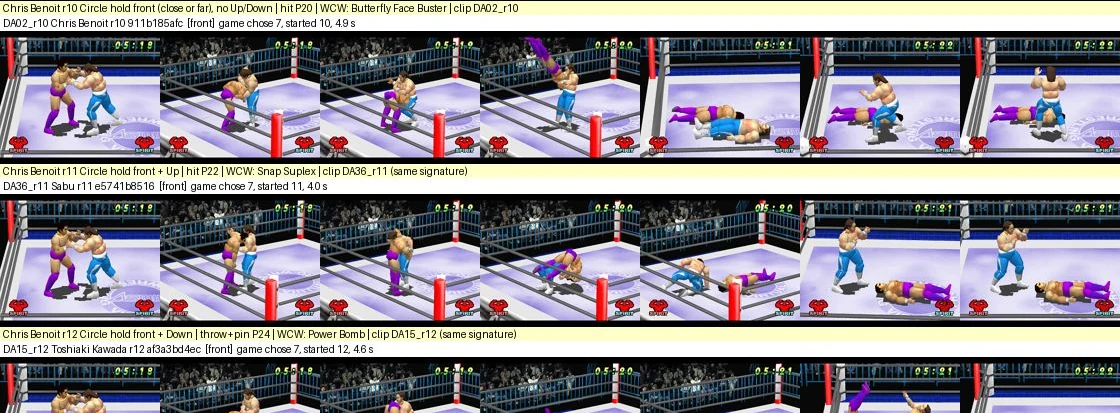
The full run was 218 jobs, nine batches, about 24 minutes, with no one touching the controller: 202 main signatures plus 16 counters, with 0 errors and 0 re-runs. Every wrestler’s signature for grapple records 4 to 20 got a clip. In total the capture covers about 590 clips.
What went wrong along the way
- Top rope. The first attempt had Benoit climb and dive out of the ring. I had poked a flag on the opponent that I guessed meant “lying”, and it meant “outside the ring”. A crashed script also let the match run to a double count-out; the snapshot restore recovered it. The real trigger turned out to be touching the ropes within 17 units of a corner, holding the diagonal and pressing Cross.
- Mislabelled records. I first assumed a far tap was records 7/8/9. Playing it in the debugger said the opposite: close is 7/8/9. I also first took records 14/15/16 for the attacker’s follow-up. They are the defender’s counter, played through the attacker’s data.
- Whiffs. Some strikes missed at the default distance (115). I re-filmed them from 90.
- Debugger artefacts. Counter clips start with one half-drawn frame, and behind-the-opponent clips start face to face because the setup turns the opponent around. Both are dropped or trimmed.
From clips to names
Filming does not name anything. For that I used the Western release, WCW vs. the World, which runs on the same engine and does have move names. Where a slot’s animation matches a WCW wrestler’s, the WCW name is a good first suggestion. I matched files by comparing how many of a file’s slot names agree with what other files call the same animation; one of them (a list that was word for word a different wrestler’s) was thrown out as a source error, and for six or so wrestlers there is no WCW list at all.
Then I watched. Each suggestion went on a validation page with its clip, and I marked it OK or typed the correct name. Several suggestions were wrong in a way that only the clip shows, such as a “360 Degree” something that turns out to be a Rolling Elbow. The result is 60 wrestlers and 2,263 named moves, and every one of the 39 move records is accounted for.
Spirit
Once I knew how a move was stored, the next question was how it plays out in the real engine, because the same move does not always go the same way. The biggest variable is spirit. It decides whether you can counter a grab, whether a pin sticks, and whether you get your finisher at all. So how does spirit change what you can attack with, and what you can defend against?
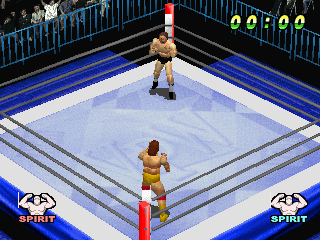
There is no health bar. Every wrestler has 255 hidden health, and the only gauge is the SPIRIT icon in each bottom corner. It runs from 0 to 100, everyone starts every fall at 50, and the icon’s colour tells you where it is.
| Spirit | Icon | What it means |
|---|---|---|
| 0-29 | almost black | no counters, easy to pin |
| 30-49 | dark red | counters possible from 36 |
| 50-69 | bright red | where every fall starts |
| 70-89 | salmon | counters likely, harder to pin |
| 90-99 | white | cannot be pinned or forced to submit |
| 100 | flashing white | the special |
It drifts back to 50 on its own: about every four seconds it falls by 1 above 50, or rises by 2 below (3 below 31). You raise it by landing moves (0 to +7), taunting with L2 (+5), leapfrogging a runner with L1 (+3), blocking a strike with Square (+2) and kicking out of a pin (+10). Getting hit costs 2-7, and going over the top rope costs 5.
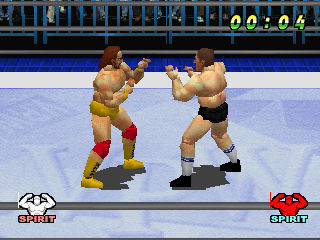
Four thresholds do the work. These come from the code, and the key ones were checked in game:
- 36: below this you cannot counter.
- 48 health: below it, every move you land gives 3 extra spirit. This is the comeback rule.
- 90: you cannot be pinned and cannot be made to give up.
- 100: the special.
At 100 your wrestler strikes a flash pose and the icon turns white. For the next 30 seconds, hold Circle next to the opponent for about a second and let go. That is the special move, record 13, with power 30 for 54 of the 60 wrestlers. The other six (Hase, Hashimoto, Baba, Fujiwara, Kitao and Hogan) have a hold instead. During those 30 seconds your spirit cannot fall and you cannot be knocked out. After exactly 30 seconds it resets to 50.
Spirit also decides how pins go. This is the formula as I traced it from the code:
T = pinner_spirit/4 + 110 - victim_HP (min -100) - victim_spirit   ; at least 2
if victim_spirit >= 90 : T = min(T, 80)
T falls 1 per tick, and 1 more per 3 face-button presses
pinfall when the count reaches 3
A pinner at 100 spirit adds 25 ticks to that timer, against 12 at spirit 50. The practical lesson is that a fresh opponent kicks out at once, and pinning someone at 90 or more spirit never works. Wear him down first, then pin while your own spirit is high.
Countering Moves
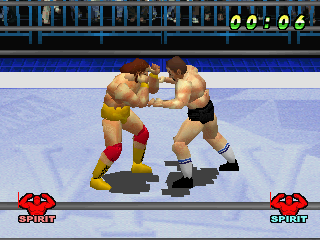
There are four different answers, depending on what is coming.
| What is coming | What to do | Chance |
|---|---|---|
| A close tap grab (or a tap from behind) | any face button right as he grabs | your spirit in percent, from 36 |
| A strong grab while dazed in a corner | face buttons straight away | each press: 3 x spirit in 1000 |
| A Cross strike | Square to guard, or Square + Cross to catch | a caught strike is reversed |
| A grab | R1 to step back | the grab misses |
The grab counter is the interesting one. The window is three frames right after the grab connects. In that window you must press a face button, your spirit has to be at least 36, and then the game rolls a random number from 0 to 1000 and the counter works if it is at most ten times your spirit. At spirit 70 that is 70%; at 100 it is guaranteed. It only works against a close tap or one from behind, never a far tap or a hold.
You are at spirit 70 and he grabs you with a close tap.
  press a face button within 3 frames   -> ok
  spirit >= 36                          -> ok
  roll 0..1000, counter if roll <= 700  -> 70% to succeed
What happens next depends on the wrestler. Most counters just free the grabbed man. In 23 of 60 wrestlers the close-tap-plus-Down counter is a throw that ends in a pin, so the grabber is the one on the mat with the referee counting. This is why the guide has a counter entry at the end of every wrestler’s move list.
A few more habits follow from this:
- Taunt when you are safe. A counter you cannot afford at spirit 20 becomes a coin flip at 50 and a sure thing at 100.
- A far tap gives the defender +8 spirit, so the weak grapple is the wrong way to start a fight against someone near the threshold.
- If you are the one at 90 or more, you cannot be pinned, so hold your counters for the close taps and take the strikes.
The Roster Guide
All of this ended up in the player’s guide: how to play, the rules, all 60 wrestlers with stats and moves, and the secrets. The full move list with inputs and names is also in docs/MOVES.md in the repository.
Download
- SYSTEM
- PlayStation
- RELEASED
- 1996
- PUBLISHER
- Asmik Ace
- PATCHED SIZE
- CD image
There are four patches in the zip: real names or parody names, each with an optional all-wrestlers-unlocked version. Patch your own copy of the Japanese disc (SLPS-00449) with Delta Patcher, then open the original .cue. It was tested in DuckStation.
#ps1#asmik#aki#patch#capture#debugger#roster-guide#spirit